
Laser cleaning vs sandblasting
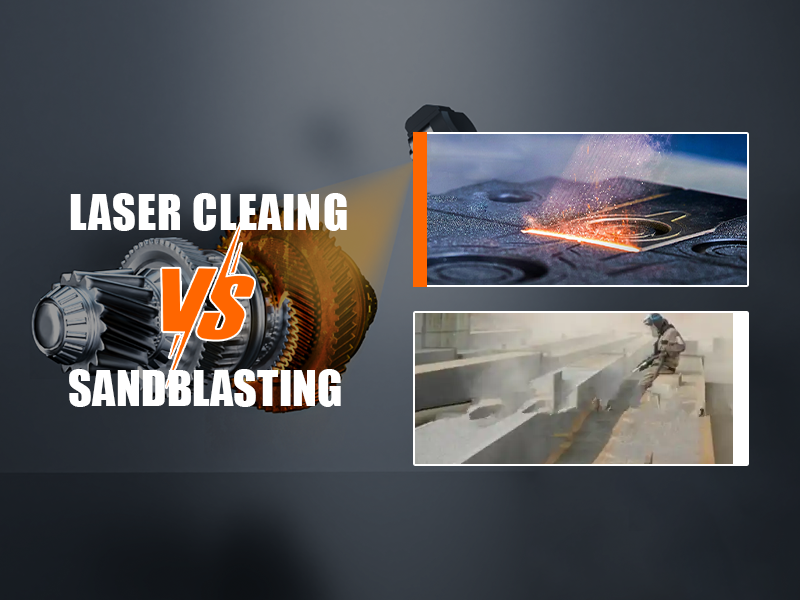
Laser cleaning and sandblasting cleaning are two common technologies in the field of industrial cleaning. Laser cleaning removes surface contaminants through high-energy laser beams, and is highly efficient, environmentally friendly, and does not damage the substrate. In contrast, sandblasting cleaning uses high-speed sprayed sand particles for physical impact, which has a higher cleaning efficiency, but may cause damage to the substrate. There are also significant differences in the application scenarios of the two. Laser cleaning is more suitable for occasions with high requirements for cleanliness and precision, while sandblasting cleaning is often used for large-area, non-rigorous cleaning tasks.
Brif conclusion:
- Laser cleaning is efficient, environmentally friendly and non-destructive, and is suitable for occasions with high requirements for cleanliness and precision.
- Sandblasting cleaning has a low cost and is suitable for large-area cleaning tasks, but it may cause damage to the substrate.
- The initial equipment investment for laser cleaning is high, but the long-term use cost is low, which is suitable for companies with sufficient budgets.
- Sandblasting cleaning performs well in dealing with stubborn stains, but attention should be paid to the impact of the generated dust on the environment and health.
- When choosing a cleaning method, efficiency, cost and environmental protection should be weighed according to specific needs and material characteristics.
- In the future, cleaning technology will develop in the direction of high efficiency, environmental protection and intelligence, and the respective advantages of laser cleaning and sandblasting cleaning will continue to be brought into play.
Laser cleaning: Principles and characteristics
Working principle of laser cleaning
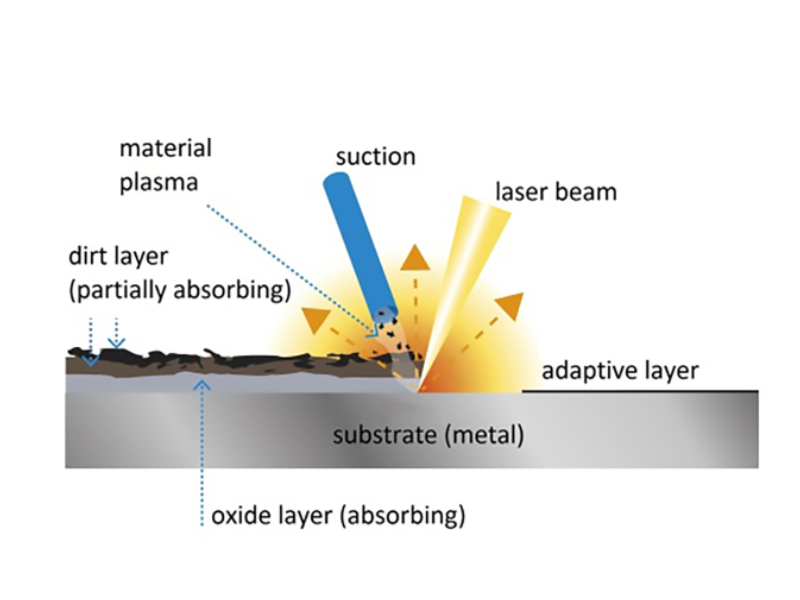
Laser cleaning is a technology based on laser ablation. A high-energy laser beam instantly irradiates the surface of an object, and the photon energy directly acts on dirt, coatings or oxides. These materials quickly absorb the laser energy and vaporize, sublimate or burn, thus detaching from the surface of the substrate. The entire process does not require contact with the workpiece, avoiding damage to the substrate by mechanical friction or chemical corrosion.
The core of laser cleaning lies in its selectivity. The laser beam can act precisely on the target contaminant without affecting the surrounding substrate. This non-contact cleaning method is suitable for workpieces with complex shapes and can even operate efficiently in small spaces.
Main Product
Featured Products
OEM & ODM SERVICE
Professional R&D Team
Pros of laser cleaning
- High efficiency: quickly remove surface contaminants
Laser cleaning uses high-temperature energy to complete the cleaning task instantly. Compared with traditional methods, laser cleaning has a shorter process and significantly improved cleaning efficiency. For example, laser can quickly remove rust, coating or oil stains on metal surfaces, saving a lot of time.
- Environmental protection: no chemical pollution, no dust
No chemical reagents or cleaning fluids are required during the laser cleaning process. The waste generated by cleaning is very small, and most of it is solid particles, which are easy to collect and handle. This green cleaning method meets modern environmental protection requirements and avoids the secondary pollution that may be caused by chemical cleaning.
- Non-destructive: no damage to the substrate surface
Laser cleaning uses non-contact operation, and the beam only acts on the surface of the contaminant, without causing mechanical wear or thermal damage to the substrate. Even for precision parts or high-value materials, laser cleaning can ensure their surface integrity.
Cons of laser cleaning
- High initial equipment cost
The high R&D and manufacturing costs of laser cleaning equipment result in a large initial investment. Although the subsequent operating costs are low, the initial investment may be a major obstacle for small and medium-sized enterprises.
- Limited adaptability to certain materials
Laser cleaning has certain requirements for the light absorption of materials. Some highly reflective materials may not effectively absorb laser energy, resulting in unsatisfactory cleaning results. In addition, laser cleaning also has certain restrictions on the thickness and type of contaminants.
Sandblasting cleaning: Principles and characteristics
Working principle of sandblasting cleaning
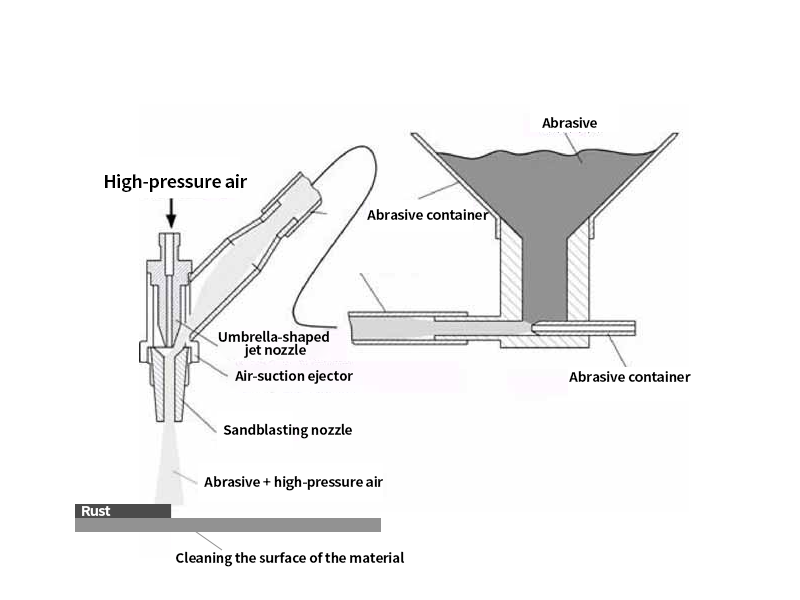
Sandblasting cleaning uses compressed air to spray sand particles at high speed onto the surface of an object. The sand particles physically collide with the surface to peel off dirt, rust or coating. During the cleaning process, the kinetic energy of the sand particles directly acts on the target area, generating strong friction and impact force. This method is suitable for removing stubborn stains or heavy coatings.
The key to sandblasting cleaning lies in the selection of sand particles. Sand particles of different materials and particle sizes are suitable for different cleaning tasks. For example, metal surfaces usually use harder sand particles, while soft materials require finer sand particles to avoid damage.
Pros of sandblasting
- Low cost: The price of equipment and consumables is relatively cheap
Sandblasting equipment has a simple structure and low manufacturing cost. The sand used in the operation is cheap and reusable. For companies with limited budgets, sandblasting is an affordable option. In addition, the maintenance cost of the equipment is low, which further reduces the overall cost of use.
- Wide range of application: It can be used for a variety of materials and surfaces
Sandblasting is suitable for a variety of materials, including metals, glass, ceramics and plastics. Whether it is a flat, curved or complex-shaped workpiece, sandblasting can provide good cleaning results. It has a wide range of applications in the industrial field, such as ship rust removal, building surface cleaning and mechanical parts processing.
Cons of sandblasting
- Possible damage to the surface: Not friendly to precision parts
The physical impact force of sandblasting is strong, which may cause damage to the surface of the substrate. Especially for precision parts or high-value materials, sandblasting may cause surface roughness or dimensional changes. This method is not suitable for occasions with high requirements for surface finish.
- Dust generation: Potential harm to the environment and operators
A large amount of dust is generated during sandblasting. This dust not only pollutes the environment, but also may pose a threat to the health of operators. Long-term exposure to dust may cause respiratory diseases. Therefore, sandblasting cleaning needs to be equipped with professional protective equipment and dust collection systems to reduce the impact on the environment and personnel.
A comprehensive comparison of laser cleaning and sandblasting cleaning
Efficiency comparison
Laser cleaning excels in efficiency. High-energy laser beams can quickly remove surface contaminants, whether rust, coatings or oil stains, and can complete cleaning tasks in a short time. This high efficiency significantly improves work efficiency in industrial production, especially for scenes that require rapid processing. In contrast, the efficiency of sandblasting cleaning is limited by equipment performance and operating conditions. Although sandblasting cleaning performs well in large-area cleaning, its cleaning speed is generally slow, especially when faced with complex shapes or precision parts, the efficiency will further decrease.
Summary: Laser cleaning is superior to sandblasting cleaning in terms of processing speed and efficiency, especially in high-precision and high-demand cleaning tasks.
Comparison of cleaning effects
Laser cleaning has a more refined cleaning effect. The laser beam can precisely act on the target contaminant without affecting the surface of the substrate. This non-contact cleaning method ensures the integrity of the substrate and is suitable for occasions with high requirements for surface finish. Sandblasting cleaning removes dirt through the physical impact of sand particles. Although it can effectively remove stubborn stains, it may cause some damage to the surface of the substrate, especially for precision parts or high-value materials. In addition, the surface treatment effect of sandblasting cleaning is relatively rough and is not suitable for cleaning tasks that require high precision.
Summary: Laser cleaning has more advantages in cleaning effect and can achieve non-destructive cleaning, while sandblasting cleaning is more suitable for tasks that do not require high surface finish.
Cost comparison
From the perspective of initial investment, the cost of laser cleaning equipment is relatively high. The research and development and manufacturing of laser cleaning machines require advanced technology, so they are expensive. However, laser cleaning does not require consumables in subsequent use, has low maintenance costs, and is more cost-effective for long-term use. The initial cost of sandblasting cleaning equipment is low, and consumables such as sand are cheap, which is suitable for companies with limited budgets. However, sandblasting cleaning requires regular replacement of consumables and is equipped with a dust collection system, which will increase the cost of long-term use.
Summary: The initial investment of laser cleaning is high, but the long-term use cost is low; sandblasting cleaning has a low initial cost, but the consumables and maintenance costs are high.
Environmental protection comparison
Laser cleaning performs well in terms of environmental protection. No chemical reagents are required during the cleaning process, and no waste liquid or harmful gases are generated. Only a small amount of solid particles are left after cleaning, which are easy to collect and treat. This green cleaning method meets the high requirements of modern industry for environmental protection. In addition, the non-contact operation of laser cleaning avoids secondary pollution to the environment, which is especially suitable for industries with strict environmental protection standards.
Sandblasting cleaning has certain environmental protection issues. A large amount of dust is generated during cleaning, which not only pollutes the environment but also may threaten the health of operators. Although pollution can be reduced by installing a dust collection system, this will increase additional equipment costs and maintenance costs. In contrast, sandblasting cleaning is obviously not as environmentally friendly as laser cleaning.
Summary: Laser cleaning has obvious advantages in environmental protection due to its characteristics of no chemical pollution and no dust, while sandblasting cleaning requires more environmental protection measures to reduce its impact on the environment.
Comparison of applicability
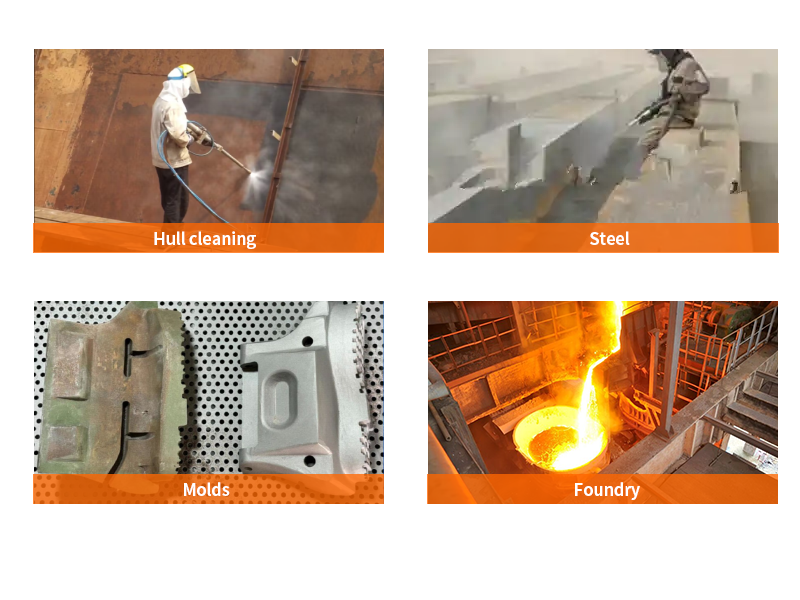
Laser cleaning has a wide range of applicability, especially in situations where cleanliness and precision are required. For example, laser cleaning is suitable for removing rust and coatings on metal surfaces and surface contaminants on precision parts. Its non-contact operation and high selectivity enable it to operate efficiently in complex shapes or small spaces. In addition, laser cleaning is particularly effective for cleaning molds, and can achieve non-destructive cleaning, avoiding surface damage that may be caused by traditional methods.
Sandblasting cleaning is more suitable for large-area cleaning tasks. Its strong physical impact force can quickly remove stubborn dirt and heavy coatings, and is widely used in ship rust removal, building surface cleaning and other fields. However, sandblasting cleaning has poor adaptability to precision parts or high-value materials, which may cause surface roughness or dimensional changes. In addition, sandblasting cleaning has limited cleaning effects on some soft materials, and the sand material and particle size must be carefully selected.
Summary: Laser cleaning is suitable for high-precision and high-demand cleaning tasks, while sandblasting cleaning has more advantages in large-area, low-precision cleaning scenarios.
Applicable scenarios and future trends of the two cleaning methods
Typical application scenarios of laser cleaning
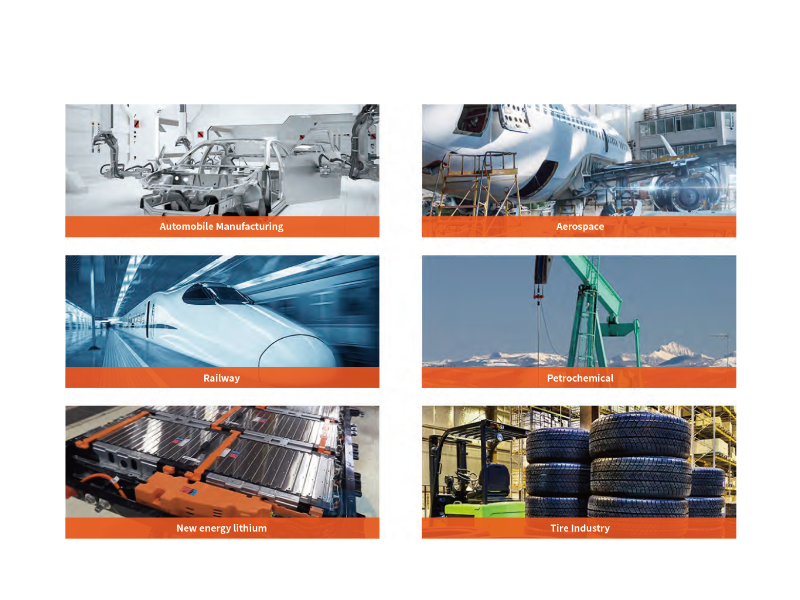
Laser cleaning performs well in situations with high precision and environmental requirements. It is widely used in aerospace, automobile manufacturing and electronics industries. For example, in the aerospace industry, laser cleaning is used to remove coatings and oxides from aircraft surfaces, ensuring material integrity and safety. In automobile manufacturing, laser cleaning is used to remove oil stains and oxide layers before welding, thereby improving welding quality. In addition, laser cleaning also plays an important role in the restoration of cultural relics. It can accurately remove dirt and aging coatings on the surface of cultural relics while protecting the original materials of the cultural relics.
Laser cleaning is also suitable for mold cleaning. Residues on the surface of the mold will affect product quality, and laser cleaning can effectively remove these residues and extend the service life of the mold. Due to its non-contact operation, laser cleaning also offers significant advantages when cleaning workpieces with complex shapes and tight spaces.
Typical application scenarios of sandblasting cleaning
Sandblasting cleaning performs well in large-area cleaning tasks. It is often used for surface treatment of ships, buildings, and mechanical equipment. For example, in the shipbuilding industry, sandblasting cleaning is used to remove rust and old coatings on the surface of the hull, providing a good foundation for subsequent anti-corrosion coating. In the field of construction, sandblasting cleaning is used to clean the exterior walls of buildings, remove dirt and aging coatings, and make the buildings look brand new.
The maintenance of mechanical equipment is also inseparable from sandblasting cleaning. It can quickly remove oil, rust and other stubborn dirt on the surface of the equipment and restore the normal function of the equipment. In addition, sandblasting cleaning is widely used in metal processing for surface roughening to improve the adhesion of coatings or adhesives.
Sandblasting cleaning has a wide range of applications, but its cleaning effect on precision parts and high-value materials is limited. Therefore, it is more suitable for tasks that do not require high surface finish.
Tell us your detail application or requirement, let recommend a suitable machine for you
Future development trends of cleaning technology
Cleaning technology is developing towards high efficiency, environmental protection and intelligence. As an emerging technology, laser cleaning will further optimize equipment performance and reduce initial investment costs in the future. With the advancement of technology, the scope of application of laser cleaning will continue to expand, especially in high-precision and high-requirement industrial fields. In the future, laser cleaning may be combined with automation technology to achieve unmanned operation and improve production efficiency.
Sandblasting cleaning is also constantly improving. The research and development of new environmentally friendly sand particles will reduce dust pollution and reduce harm to the environment and operators. At the same time, the intelligent upgrade of sandblasting cleaning equipment will improve cleaning efficiency and reduce waste of consumables.
Overall, laser cleaning and sandblasting cleaning will continue to develop in their respective areas of strength. Laser cleaning will become the mainstream choice for high-end industrial cleaning, while sandblasting cleaning will remain competitive in large-area and low-cost cleaning tasks. In the future, the two technologies may be used in combination to meet the cleaning needs of different scenarios.
Laser cleaning and sandblasting cleaning each have their own advantages and disadvantages. Laser cleaning is highly efficient, environmentally friendly, and does not damage the substrate, but the equipment cost is high and its adaptability to certain materials is limited. Sandblasting cleaning is low-cost and has a wide range of applications, but it may damage the surface and produce dust pollution. It is particularly important to choose the appropriate cleaning method according to the specific needs of the cleaning task. In the future, cleaning technology will develop in the direction of high efficiency, environmental protection, and intelligence, providing more possibilities for industrial cleaning.